Behind the screens: The growing first party fraud crisis in gaming
Gaming lost $2.8 Billion to fraud in 2024: Are the fraudsters winning? Join us in the fight against first party fraud
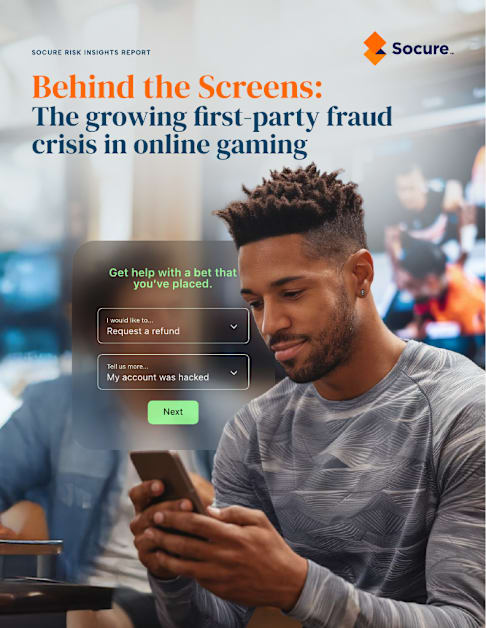
Behind the Screens:
The growing first-party fraud crisis in online gaming
Socure Risk Insights Report
I would like to...
Request a refund
Tell us more...
My account was hacked
Next
Get help with a bet that you’ve placed.
3
← Account
9:41
What can we help you with?
I would like to...
Dispute a losing bet
Tell us more...
My account was hacked
Bet was placed accidentally
Next
Dispute a bet
What can we help you with?
I would like to...
Dispute a losing bet
Tell us more...
My account was hacked
Bet was placed accidentally
Next
The online gaming industry is thriving like never before.
The rise of online platforms and real-time wagering has transformed online gaming into a $114 billion1 global industry, now legal in 38 U.S states2 and projected to grow 10.5% annually through 2030.3
But this rapid growth comes at a cost: First-party fraud.
Socure recently surveyed consumers to uncover why first-party fraud thrives in online gaming. With the Super Bowl approaching — a peak time for gaming activity — last year’s data shows how such events trigger surges in fraud, with disputes and manipulations overwhelming platforms during their busiest season.
First-party fraud, or the use of one's own identity to commit a dishonest act for personal or financial gain, is hitting the online gaming industry harder than any other sector. In 2024, online gaming accounted for 55% of all first-party fraud incidents, despite it representing only 15% of online transactions.
Bet big,
cheat bigger
2
In online gaming, first-party fraud can involve disputing bets under the pretense of account hacking, falsely claiming losing bets as accidental to secure a refund, or providing fake details to exploit promotions.
What’s worse, major events like the Super Bowl can send first-party fraud attempts into overdrive — and offenders view their actions as a victimless crime rather than outright fraud.
As bettors flood platforms during these high-profile games, disputes over losing bets, claims of account hacking, and coordinated efforts to manipulate payouts spike, piling extra strain on online gaming industry during their busiest season.
Beyond the financial hit, first-party fraud also erodes trust, forcing stricter policies that can frustrate legitimate users and undermine the fairness that keeps bettors loyal.
Needless to say, as the online gaming industry continues to boom, addressing these first-party fraud challenges will be crucial to protecting revenue, maintaining user trust, and ensuring long-term growth in an increasingly competitive market.
This report explores the drivers behind first-party fraud in online gaming, its impact on fairness and trust, and offers practical strategies gaming organizations can use to safeguard their platforms and uphold the integrity of the industry.
Small bets dominate these disputes, with most averaging $109. However, with roughly 1 in 10 Americans admitting to disputing losing bets on sports sites, the total potential annual losses for the online gaming industry amount to an estimated $2.8 billion.
$2.8 billion The total potential annual losses
from first-party fraud for the online
gaming industry.
Methodology
Socure conducted this research
using an online survey prepared by
Method Research and distributed by
PureSpectrum among n=2,000
adult U.S. consumers (age 18+) who
have made a purchase in the last six
months. The sample was split
equally between genders, with a
spread of age groups, race groups,
and geographies. Data was
collected from December 6 to
December 13, 2024.
3
4
1
2
The Big Game’s big problem: First-party fraud
Motivations for online gaming first-party fraud are both economic and psychological
25%25%26%28%28%
91%
92%
40% 46%
With widespread betting activity, it serves as the perfect backdrop for deceptive tactics aimed at �manipulating outcomes and avoiding losses.
The Super Bowl is the peak season for online gaming fraud, with risky transactions jumping more �than 206% on Super Bowl Sunday last year, compared to average volume of NFL playoff games.4� Some of the most common schemes include:
Online gaming first-party fraud is fueled by a mix of perceived opportunity and moral justification. �Offenders exploit weak points, driven by the belief that their actions carry little consequence for gaming platforms. Many online gaming fraudsters don’t view their actions as theft but rather as a low-risk, high-reward loophole.
5
3 Bettor's remorse: Using deception to game the system
26%
20%
26%
4 Small bets add up to almost $3 billion in losses annually
with 31% being less than $50.
Over half (56%) of fraudulently disputed bets are under $100
With 1 in 10 Americans admitting to disputing losing bets on sports sites and an average disputed bet of $109, �the math reveals the scale of the problem. Assuming a U.S. adult population of approximately 250 �million, that’s 25 million individuals. Multiply that by $109 per dispute, and the result is �a staggering $2.8 billion in potential annual losses for the online gaming industry.
5 No regret, no remorse: The psychology behind online gaming fraud
23%
24%
43%
46%
A striking lack of accountability defines many online gaming fraud cases. Offenders often show �no concern for consequences – and even less remorse for their actions.
Of offenders who had no concern for consequences...
falsely claimed ‘never made’ bets
disputed legitimate losses
Of offenders who express no regret for their actions...
claimed their bets were 'never made'
disputed their losses
56%
31% $113 $109
Average value of bets falsely claimed as
‘never made’
Average value disputed for legitimate losing sports bets
create �alternative accounts �to continue betting �during disputes
provide �false personal details to �qualify for promotions and �access services.
10
The future of fair play in
online gaming
There’s no question that the online gaming industry is booming — but alongside its rapid growth comes a troubling rise in first-party fraud.
Major events like the Super Bowl only intensify the problem, as bettors resort to deception — falsely claiming hacked accounts, disputing losses, and coordinating schemes — to defraud online gaming platforms of millions of dollars, while also chipping away at the trust and fairness that keep bettors engaged.
And with little remorse from offenders, online gaming platforms are stuck trying to stop fraud without alienating honest users.
AI-powered fraud detection, real-time data sharing, and cross-industry collaboration can counter fraud spikes during events like the Super Bowl. With these tools, platforms can combat false claims, disputed losses, and payout schemes while ensuring fair, seamless betting for legitimate users.
Socure's First-Party Fraud Consortium unifies organizations to take on this complex
challenge by pooling data and insights.
Our consortium members have contributed:
20B+ transactions
325M+ accounts
190M+ identities
121M+ unique identities
Socure's solution combines the
industry's largest cross-industry consortium data with advanced AI
analytics to stop repeat abusers and prevent financial losses at scale.
By delivering real-time risk signals and alerts across the entire customer journey,
Socure helps organizations protect their bottom line while maintaining seamless
experiences for legitimate customers.
Sigma First-Party
Fraud
13
Citation
The Business Research Company. "Online gaming Global Market Report." The Business Research Company, 202 Investopedia. "Online gaming Laws by State." Investopedia, 2025 Grand View Research. "U.S. online gaming Market Report." Grand View Research, 202 Statista. "App Fraud Value by Category." Statista, 202 Socure. "Risky Transactions on Super Bowl 2024." Socure Blog, 2024
socure.com © Socure 2025, Inc. All rights reserved. REP_8268923826-01
Socure is the leading provider of digital identity verification and fraud prevention solutions, trusted by the largest enterprises and government agencies to build trust and mitigate risk. Leveraging AI and machine learning, Socure’s industry-leading platform achieves the highest accuracy, automation and capture rates in the industry. With the acquisition of Effectiv, Socure expands its capabilities to offer end-to-end identity fraud and payment risk management, integrating advanced transaction monitoring, credit underwriting and know-your-business (KYB) solutions into its platform.
Serving more than 2,800 customers across financial services, government, gaming, healthcare, telecom, and e-commerce, Socure’s customer base includes 18 of the top 20 banks, the largest HR payroll providers, the largest sportsbook operators, 27 state agencies, four federal agencies, and more than 500 fintechs. Leading organizations including Capital One, Citi, Chime, SoFi, Green Dot, Robinhood, Dave, Gusto, Poshmark, DraftKings, PrizePicks, the State of California and many more trust Socure to deliver certainty in identity across onboarding, authentication, payments, account changes, and regulatory compliance. Learn more at www.socure.com.
Learn more →
See how Socure can help solve for
first-party fraud.
http://www.thebusinessresearchcompany.com/report/sports-betting-global-market-report http://www.investopedia.com/sports-betting-laws-by-state-5219064 http://www.grandviewresearch.com/industry-analysis/us-sports-betting-market-report http://www.statista.com/statistics/1380417/app-fraud-value-by-category/ https://www.socure.com/blog/risky-transactions-on-super-bowl-2024 https://www.socure.com/products/sigma-first-party-fraud